How to Build a Code-Compliant ADU in Arvada
Your guide to Arvada ADU rules: lot coverage, setbacks, utilities, water tap fees and the permit steps to build a legal accessory dwelling unit.
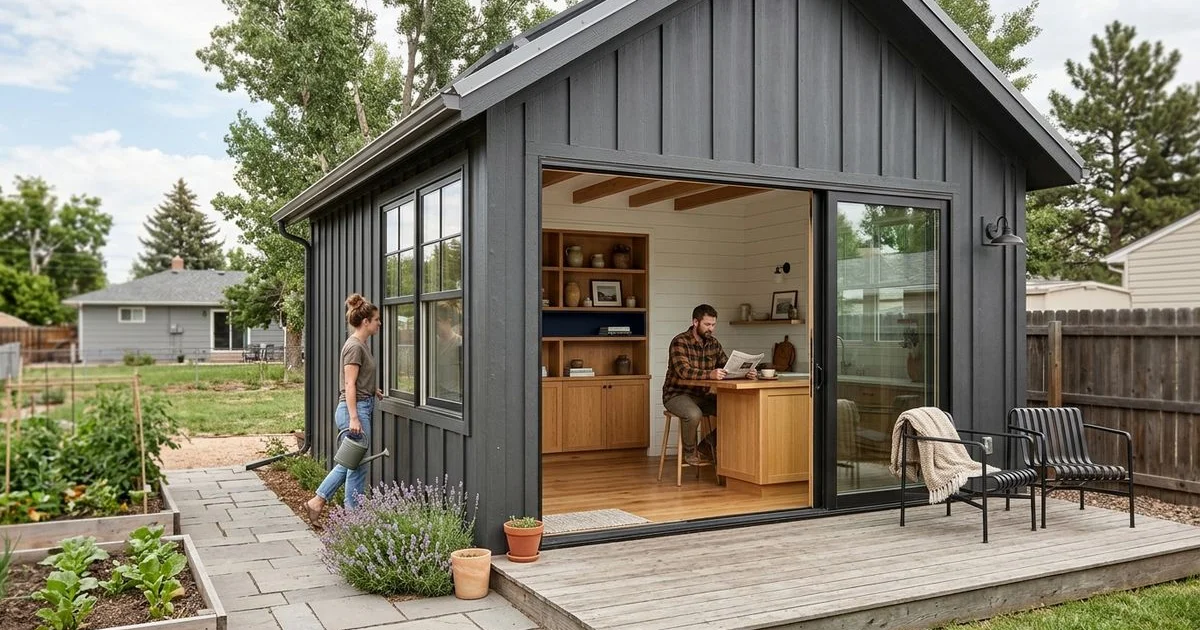
From what we see locally, the recent push for more housing has completely shifted how homeowners view their backyards.
State law HB 24-1152 passed recently, making backyard builds a legal right across the Denver metro area. This regulatory shift strips away the old HOA outright bans and mandatory public hearing requirements. So, we are going to break down exactly how the updated adu rules arvada enforces affect your build, and how to get your project approved locally.
What “code-compliant” means for an Arvada ADU
A code-compliant accessory dwelling unit in Arvada must satisfy three distinct layers of rules: zoning laws for placement, building codes for safety, and utility requirements for connections. Securing all three approvals gives you a legal, rentable, financeable, and sellable second dwelling on your property. Missing any of these steps leaves you with an unpermitted structure that actively hurts your home value at resale.
Our team at Arvada Remodeling Pros handles these exact compliance steps on every Arvada ADU construction project we take on.
This proactive approach saves homeowners from costly tear-downs later. We often see DIY builds flagged by inspectors because they ignored the updated 2024 International Residential Code standards. Protecting your investment starts with proper planning.
Zoning: where the ADU can sit
The adu regulations arvada enforces dictate exactly where a unit can sit, focusing heavily on lot coverage, setbacks, and building height. Before design even begins, it is worth checking whether your parcel qualifies at all, which we cover in detail in can I build an ADU on my Arvada lot. Your specific zoning district sets the baseline, but the city utilizes strict square footage limits based on your total lot size. For example, lots under 6,000 square feet are capped at a 600-square-foot structure, while lots over one acre can build up to 1,200 square feet.
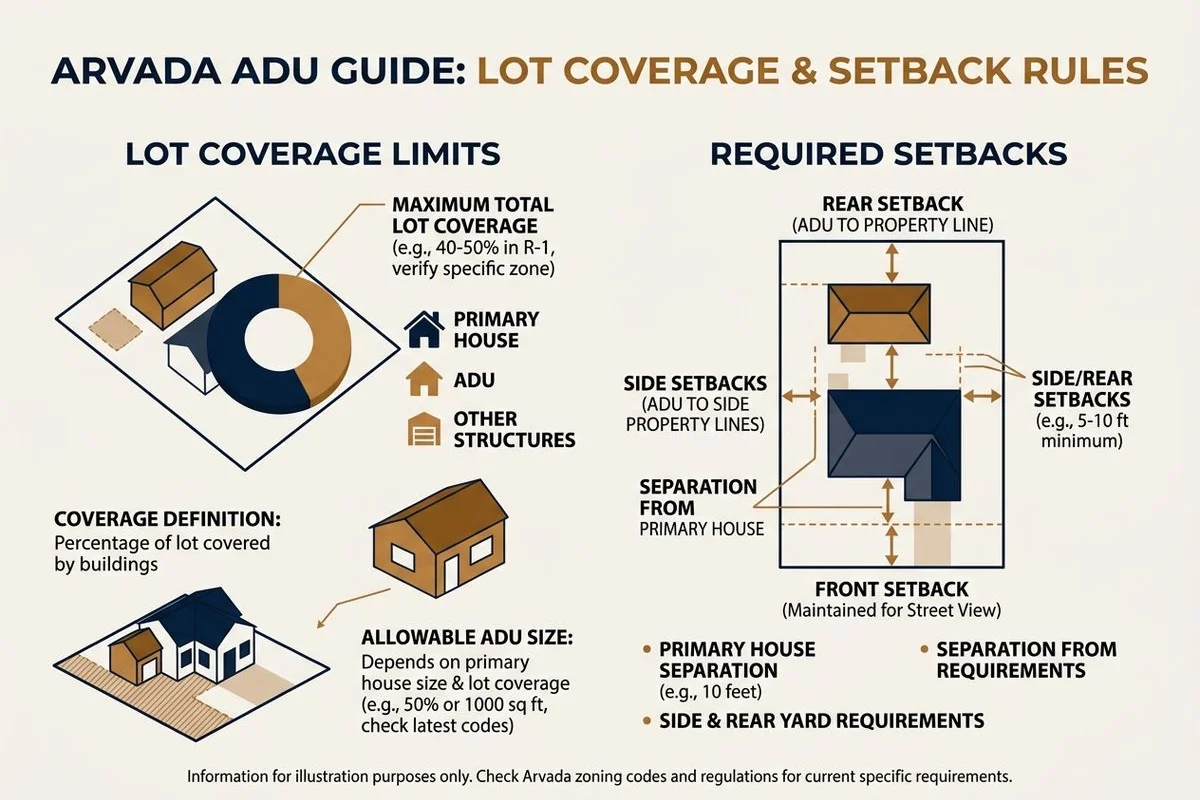
- Lot coverage ratio: The city calculates lot coverage by dividing the total square footage of all structures by the lot area. Most residential districts in Arvada cap this coverage at 30% to 40%. Garage conversions offer a distinct advantage here because they do not add any new coverage to your footprint.
- Setbacks: Property line distances remain strictly enforced. Front setbacks usually require 25 feet of clearance, side setbacks demand 5 to 10 feet, and rear setbacks need 15 to 25 feet. Corner lots carry an extra rule, requiring detached units to sit at least 10 feet behind the main home’s front facade.
- Height limits: Most residential districts restrict backyard structures to 24 feet in height. Single-story builds face fewer approval hurdles and blend better into established neighborhoods.
- Owner occupancy: The city enforces a strict occupancy rule to prevent purely investor-driven development. Either the primary home or the new accessory unit must be occupied by the property owner.
- Parking: Certain dense districts mandate the addition of one off-street parking space for the new unit.
Building code: how it’s built
Building code dictates the precise construction methods required once your zoning gets approved. The city evaluates all projects against the International Residential Code, and Arvada is actively preparing for the 2026 adoption of newer structural requirements. Passing these inspections requires strict adherence to energy compliance, structural integrity, and life-safety systems.
- Foundation: Front Range soil conditions, especially the Pierre Shale found in Jefferson County pockets, often require an engineered slab or stem-wall foundation.
- Framing: Exterior walls need 2x6 framing to meet modern energy compliance standards, along with proper headers and structural sheathing.
- Insulation: Current International Energy Conservation Code (IECC) mandates R-21 insulation in the walls and a minimum of R-49 in the attic.
- Egress: Every single bedroom must feature a compliant egress window for emergency exit.
- Safety detectors: Hardwired smoke and carbon monoxide detectors with battery backups are mandatory throughout the space.
- Bathroom ventilation: Moisture must vent directly to the exterior, never into an attic.
- Mechanical: You must install a dedicated HVAC setup or a ductless mini-split system.
Our project managers schedule mandatory city inspections at the foundation, framing, MEP rough-in, insulation, drywall, and final completion stages.
Missing just one of these sign-offs will force you to rip open finished walls. We always coordinate these walk-throughs in advance to keep the build schedule tight. This keeps the crew moving without costly downtime.
Utilities: power, water, sewer
Utility hookups represent the largest hidden cost and the primary reason most backyard builds stall. The specific utility requirements change drastically depending on whether you build a standalone structure or convert existing space. Getting these connections wrong can trigger five-figure municipal penalties.
We see homeowners get blindsided by the Metro Water Recovery System Development Charge (SDC).
This single sewer capacity fee currently costs $5,910 before you even start digging. We strongly advise pulling the exact tap fee schedule for your address early in the planning phase. Accurate budgeting prevents mid-project surprises.
Comparing Utility Scenarios
Different project types trigger vastly different utility costs.
| ADU Type | Water & Sewer Connections | Electric & Gas Power |
|---|---|---|
| Detached Structure | Separate tap required ($8,000 to $15,000 fee). Long lateral trenching adds $3,000 to $8,000. | Requires a separate electric meter and dedicated gas service line. |
| Attached Addition | Shares main home connections. May trigger Metro Water Recovery SDC. | Usually requires a heavy-up sub-panel installation. |
| Garage Conversion | Extends existing plumbing from the main house. Lowest trenching costs. | Uses existing main panel if capacity allows. |
| Basement Conversion | Utilizes existing main-home utilities entirely. | Minimal upgrades needed unless adding large appliances. |
The permit process
The Arvada permit process requires administrative approval through the Building Division, moving linearly from initial design to final occupancy. The recent HB 24-1152 state legislation removed the public hearing requirement, making this an administrative checklist rather than a political battle. Following the exact sequence prevents application rejections.
The standard progression includes these specific milestones:
- Pre-application meeting with the Building Division to review lot viability.
- Plan submission including architectural drawings, stamped structural engineering, and a detailed site plan.
- City review phase, which typically takes 8 to 12 weeks for full evaluation.
- Permit issuance covering the primary building, electrical, plumbing, mechanical, and utility taps.
- Stage inspections conducted by city officials during construction.
- Certificate of occupancy granted at the final walk-through.
Projects located in unincorporated Jefferson County follow a parallel path through the jefferson county adu approval channels. These county properties often face different water rules, sometimes requiring explicit permission from a public water district or a state well permit modification.
How we make it easier
We handle this exact regulatory process from the first soil test to the final certificate of occupancy.
The in-house team pulls your specific parcel data, calculates the strict lot coverage ratios, and maps the most cost-effective utility trenching paths. We also submit the plans directly to the city reviewers. Handing off this paperwork prevents the common delays that plague inexperienced builders.
Talk to our team about your property lines before spending money on architectural blueprints.
A quick feasibility check reveals exactly what the city will allow on your specific street. We secure the permits, manage the municipal inspectors, and get your new space approved legally and efficiently. Your property potential is waiting to be maximized.
Frequently Asked Questions
Are ADUs allowed in Arvada?
Do ADUs need separate utilities?
How long does the ADU permit process take?
More Guides in This Series
How Much Does It Cost to Build an ADU in Arvada?
ADU costs in Arvada by type — detached, attached and garage-conversion. See the price drivers and how rental income offsets the build.
How Much Rental Income Can an Arvada ADU Generate?
Arvada ADUs commonly rent for $1,500-$2,500/month. See the payback math, multigenerational uses and rental demand across the Denver metro.
ADU vs. Home Addition: Which Is Better for Your Goals?
Choosing between an income-capable ADU and an attached addition? Compare privacy, income, cost, permitting and resale impact.
Can I Build an ADU on My Property? Arvada Lot Coverage & Setbacks
Find out if your Arvada lot qualifies for an ADU. Learn the lot size, zoning, coverage and setback factors and how a feasibility assessment works.
Learn more about Home Additions & ADU Construction
Ready to talk through your specific project? We'll meet you at home and walk through realistic budget and timeline ranges.