How Much Rental Income Can an Arvada ADU Generate?
Arvada ADUs commonly rent for $1,500-$2,500/month. See the payback math, multigenerational uses and rental demand across the Denver metro.
We know that maximizing your property value is a top priority for Colorado homeowners right now. The recent passage of Colorado House Bill 24-1152 has completely shifted the landscape, making Accessory Dwelling Units easier to permit and build than ever before.
This legislative change means what used to be a frustrating zoning battle is now a straightforward path to generating reliable cash flow.
Our team at Arvada Remodeling Pros has watched these home addition and ADU projects solve housing needs while building serious equity. You will find that local demand continues to outpace available inventory across the metro area. Here is a detailed breakdown of the ADU rental income Arvada homeowners can expect, the payback math, and the local regulations required for success.
What Arvada ADUs actually rent for
Our data shows that long-term rents for Arvada-area ADUs in 2026 generally fall between $1,400 for a studio and $2,800 for a two-bedroom space. Local market reporting from Rentometer confirms that the average Arvada rent has climbed to roughly $1,850 per month across all property types.
Studios alone command around $1,650 to $1,712 monthly in today’s highly competitive environment. We see clients consistently achieve strong returns when they price their units correctly based on current neighborhood metrics.
| ADU Size | Typical Monthly Rent |
|---|---|
| Studio (300-450 sq ft) | $1,400 - $1,700 |
| Small 1-bedroom (450-650 sq ft) | $1,600 - $2,000 |
| Standard 1-bedroom (650-850 sq ft) | $1,800 - $2,300 |
| 2-bedroom (850-1,000 sq ft) | $2,100 - $2,800 |
Rent depends on finish quality, parking availability, separate entrance and yard access, location within Arvada, and whether utilities are included. Units located within a quick walk of the G Line or the pedestrian-friendly zones of Olde Town Arvada command the highest premiums.
Our team always recommends analyzing your exact block before setting a final asking price. Including utilities in the flat monthly rate is a proven strategy to simplify billing and attract premium tenants quickly. Tenants appreciate the predictability of a single housing payment each month.
The payback math
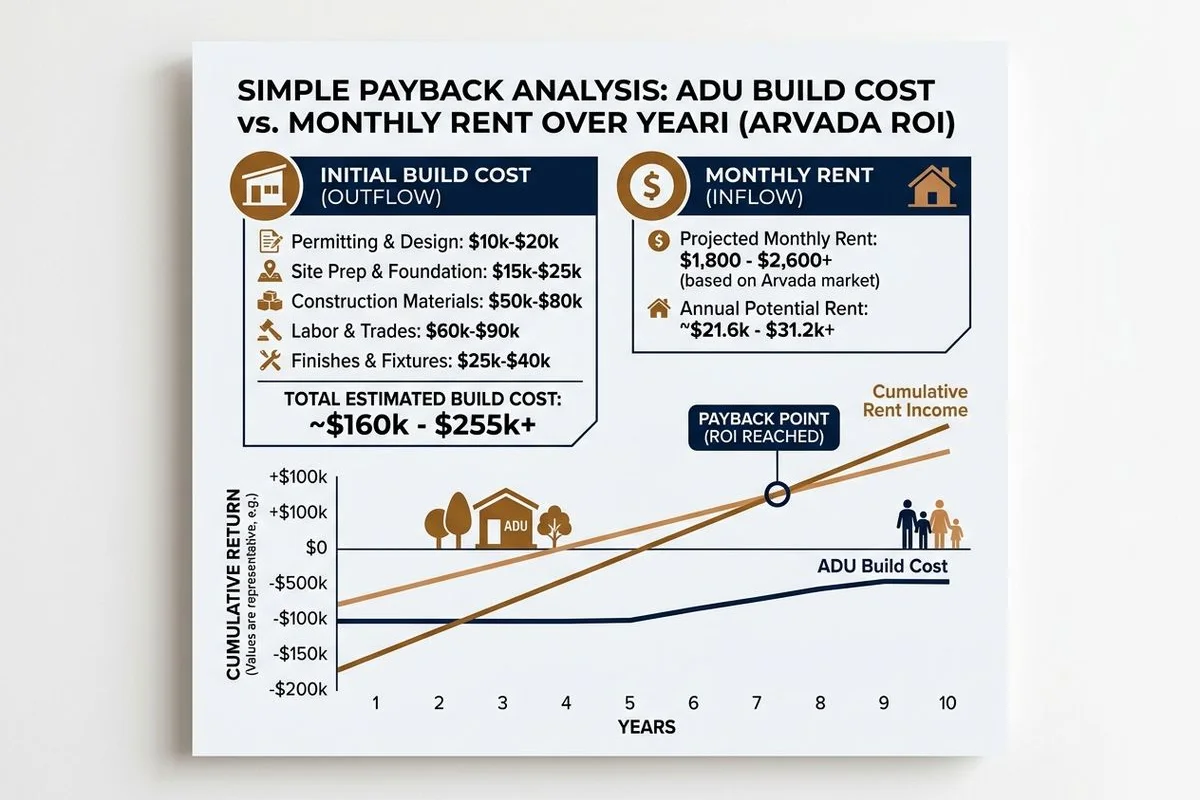
We look at a typical detached ADU build in Arvada at $180,000, renting for $2,000 a month long-term. This specific calculation results in a simple payback period of 8 to 10 years, making it an incredibly reliable real estate investment.
Initial first-year cash flow might feel tight due to setup costs, but the long-term ADU ROI Colorado investors see is substantial. Our financial models incorporate the 2026 market analysis indicating that ADU-equipped Arvada homes have been appraising at $80,000 to $120,000 premiums over comparable non-ADU properties. That means a significant portion of your build cost is recovered as immediate equity, not just over time.
Operating expenses must be factored in to give you a clear picture of the annual math.
Gross annual rent: $24,000
Operating expenses:
- Property tax delta (added value): $1,200
- Insurance increase: $600
- Maintenance reserve (5% of rent): $1,200
- Vacancy allowance (5%): $1,200
- Property management (if used, 8-10%): $0 to $2,400
We calculate net annual income to typically land between $19,800 and $22,000 if you are self-managing, or $17,400 to $19,400 with a professional property manager. Hidden utility tap fees can break a budget, so planning for Denver Water System Development Charges early is critical. These figures still do not include the tax benefits of investment property income, which are real and meaningful for most homeowners with W-2 income.
Multigenerational uses
Our custom builds show that not every Arvada ADU becomes a rental property, as many families construct them specifically for multigenerational living. These flexible spaces provide independent housing for aging parents or adult children while keeping everyone on the same property.
A 2025 Pew Research Center study highlights that multigenerational living is rising sharply across the United States due to housing costs and caregiving requirements. We frequently design these units with accessibility features for families planning ahead for long-term care needs. Many serve as:
- Aging parents’ independent housing. Privacy and accessibility for parents who want to be close but not in the same kitchen.
- Adult kids returning home. Real housing for a recent college grad or one between situations, without making your kitchen a shared space.
- Home office at meaningful distance. A 600 sq ft detached office is a very different workday than a corner of the dining room.
- Guest suite for extended visits. When the in-laws come for three weeks, an ADU keeps the family functional.
The income case is the headline, but the lifestyle case is often what gets families to commit. Our ADU clients frequently build for personal use first and budget for eventual rental income later down the line. Flexibility is the true value of adding a secondary structure to your lot.
Generational living arrangements offer a practical solution to modern family challenges.
Short-term vs long-term rentals
We consider long-term rental with 12-month leases straightforward in Arvada, and the math above assumes this traditional model. Short-term rental platforms like Airbnb or VRBO can generate more gross revenue, but they come with significantly more regulatory hurdles.
The City of Arvada updated its short-term rental rules in 2026, raising the annual license fee to $350 and restricting permits exclusively to real persons over 18 rather than LLCs. Our team strongly advises most homeowners to start with a standard annual lease to build a solid operational foundation before pivoting to vacationers. These updated regulations also enforce a gradual step-down limit on how many permits one individual can hold.
Operating a short-term unit introduces specific challenges:
- Licensing requirements in Arvada (rules change periodically, so check the current 2026 short-term rental ordinance).
- Higher operating expenses including professional cleaning, regular supplies, and management software.
- More vacancy risk during off-seasons when tourism drops.
- More wear and tear on the unit from constant turnover.
- Strict enforcement provisions tied to new ordinances regarding noise and property maintenance.
We track data showing that during high season, Arvada ADUs can generate $3,500 to $5,000 a month in short-term rental gross revenue. Hitting those numbers requires active management or a paid management service handling the daily guest communication. Most owners find that starting long-term allows them to consider the short-term market later once they are comfortable being a landlord.
Demand context across Greater Denver
Our market analysis shows that the average ADU rent Denver properties command has kept the regional market consistently strong. Arvada specifically benefits from its unique blend of transit access, historic charm, and relative affordability compared to Boulder and central Denver.
Recent infrastructure upgrades are driving this neighborhood demand even higher. We see steady interest from young professionals and downsizers actively seeking these exact types of living spaces. The Olde Town Arvada Strategic Reinvestment Plan recently finalized the permanent closure of several streets to vehicle traffic, creating a highly desirable, walkable district that attracts premium renters.
Local dynamics strongly support high occupancy rates:
- Light rail access via the G Line connecting directly to downtown Denver.
- A walkable Old Town Arvada with expanding dining, entertainment, and pedestrian-only zones.
- Highly rated Jefferson County School District boundaries that draw families with adult kids returning home.
- A growing local job market extending into neighboring Westminster and Broomfield.
- A streamlined permitting process due to the statewide impact of House Bill 24-1152.
Our research confirms these dynamics support the rent ranges quoted and suggest continued strength for ADU rental demand through the 2030s. Reaching out for professional guidance is the best way to determine your exact property potential. Please Talk to our team about whether your lot can host an income-generating ADU, and what specific rent your build could command.
Frequently Asked Questions
How much can I rent an ADU for in Arvada?
How long until an ADU pays for itself?
Are short-term rentals (Airbnb) allowed in Arvada?
More Guides in This Series
How Much Does It Cost to Build an ADU in Arvada?
ADU costs in Arvada by type — detached, attached and garage-conversion. See the price drivers and how rental income offsets the build.
ADU vs. Home Addition: Which Is Better for Your Goals?
Choosing between an income-capable ADU and an attached addition? Compare privacy, income, cost, permitting and resale impact.
Can I Build an ADU on My Property? Arvada Lot Coverage & Setbacks
Find out if your Arvada lot qualifies for an ADU. Learn the lot size, zoning, coverage and setback factors and how a feasibility assessment works.
How to Build a Code-Compliant ADU in Arvada & Jefferson County
Your guide to Arvada ADU rules: lot coverage, setbacks, utilities, water tap fees and the permit steps to build a legal accessory dwelling unit.
Learn more about Home Additions & ADU Construction
Ready to talk through your specific project? We'll meet you at home and walk through realistic budget and timeline ranges.