Can You Build an ADU on Your Arvada Property?
Find out if your Arvada lot qualifies for an ADU. Learn the lot size, zoning, coverage and setback factors and how a feasibility assessment works.
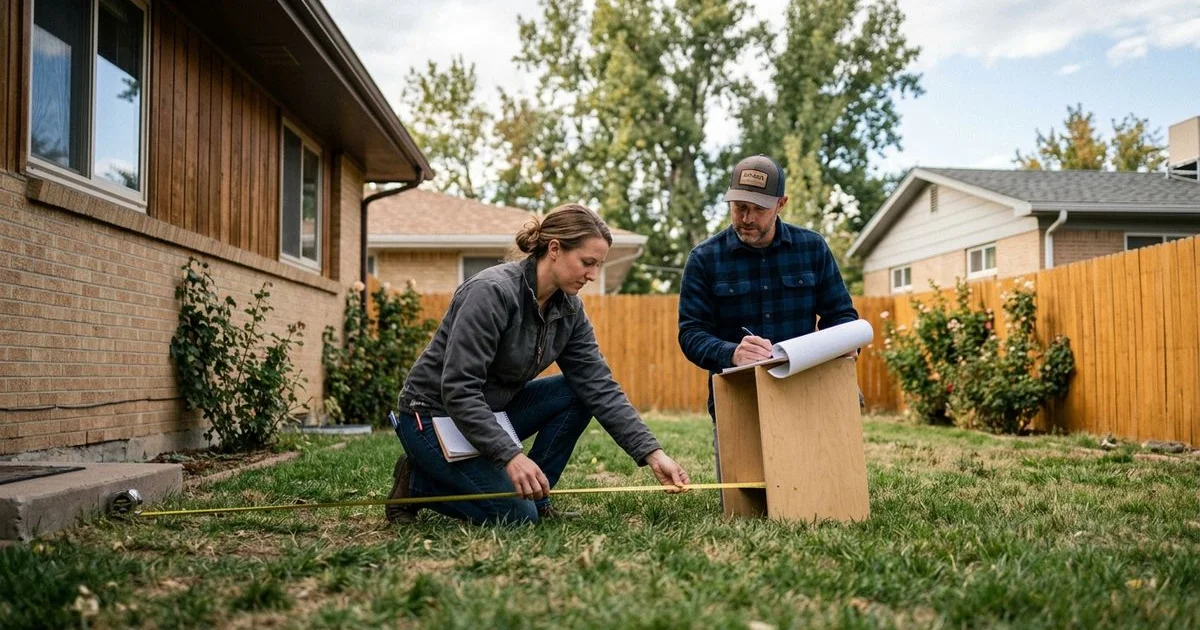
Many homeowners ask us, can I build an ADU in Arvada?
The recent implementation of Colorado House Bill 24-1152 has completely reshaped the answer to that question. This state law requires municipalities to allow accessory dwelling units by right in single-family zones, clearing away many old hurdles. Our Arvada Remodeling Pros team handles home additions and ADUs across the city, and we see this as a massive win for property owners wanting rental income or extra space.
Let’s look at the current data, what it actually means for your property, and explore the four practical factors that decide your project’s fate.
Can I build an ADU in Arvada? The four factors that decide feasibility
Whether your Arvada property can host a secondary unit comes down to four specific requirements. You must satisfy zoning, lot coverage math, the ADU setbacks Arvada requires, and utility access. Miss any of them and the project might need a different approach.
1. Zoning district
Arvada recognizes two distinct unit types: Type A detached buildings and Type B attached or interior conversions. Most single-family residential zones now allow these units as a permitted right.
We start every project by identifying your specific zoning district through the City of Arvada parcel records, then check it against the full code-compliant ADU rules for Arvada and Jefferson County. This step confirms your baseline eligibility before you spend a dime on design. The 2026 guidelines dictate that your maximum allowed size depends directly on your total lot area.
- Lots up to 6,000 sq ft: Capped at 600 sq ft
- Lots 6,001 to 12,499 sq ft: Capped at 850 sq ft
- Lots 12,500 sq ft to 1 acre: Capped at 1,000 sq ft
- Attached Type B units: Limited to 50% of the principal dwelling floor area
2. Lot coverage math
Lot coverage represents the percentage of your land taken up by all structures, including the main home, garage, and decks over 30 inches. Your proposed ADU lot coverage Arvada regulations typically cap this total at 30 percent for most residential districts.
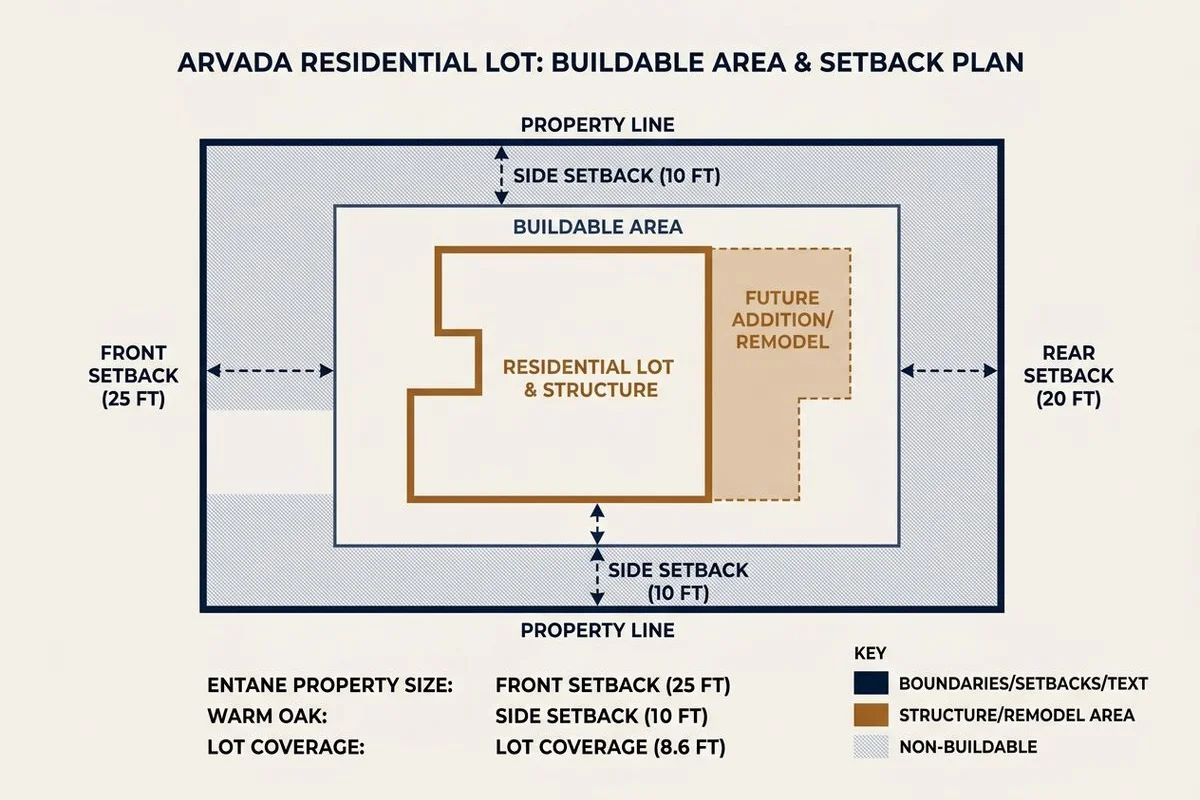
We use a simple calculation to find your remaining buildable space. The math is straightforward but strictly enforced by local planners. Here is how it looks on a hypothetical 8,000-square-foot ranch property:
| Structure Type | Area | Percentage of Lot |
|---|---|---|
| Total Lot Size | 8,000 sq ft | 100% |
| Coverage Cap (30%) | 2,400 sq ft maximum | 30% |
| Existing Home Footprint | 1,400 sq ft | 17.5% |
| Existing Garage | 480 sq ft | 6% |
| Existing Total | 1,880 sq ft | 23.5% |
| Remaining Available | 520 sq ft | 6.5% |
On this example lot, you can add a detached unit of up to 520 square feet. That footprint easily accommodates a one-bedroom layout with a kitchenette and bath.
Our design team often pivots to a garage conversion or a vertical addition if your existing structures already exceed the 30 percent cap. A vertical expansion allows you to bypass the horizontal footprint limits.
3. Setbacks
Setbacks dictate exactly how close to the property lines your new structure can sit. The updated 2026 Arvada residential rules mandate specific distances for new construction.
- Front: 25 feet (applies mostly to attached additions)
- Rear: 5 feet (updated minimum for detached units)
- Side: 5 feet (updated minimum)
- Corner Lots: 10 feet behind the main home’s street-facing facade
We must also account for a maximum height limit. This requirement usually caps the structure at 24 to 25 feet depending on your specific zone.
These setback lines carve out a smaller rectangle inside your yard. You might have 60 feet of rear depth, but subtracting the 5-foot buffer and construction access leaves a buildable area of roughly 30 by 25 feet.
4. Access and utilities
Practical site conditions will stop a project even if your zoning and math are perfect. Two major hurdles consistently dictate the final budget.
- Access for construction equipment: Moving heavy machinery requires clear, wide access paths. Side-yard clearance must be wide enough for a concrete truck or framing material staging. Properties built lot-line to lot-line often require expensive craning.
- Utility paths and capacity: Arvada requires the new unit to connect directly to the primary home’s water and sewer service lines.
This requirement triggers specific capacity fees. A Metro Water Recovery System Development Charge applies if you install new plumbing fixtures.
As of recent fee schedules, this charge adds $5,910 to your permit costs. Our electricians also evaluate your power supply, as Xcel Energy might require a new sub-panel depending on your current main panel capacity. Running a completely separate meter is usually reserved for specific detached garage scenarios and adds significant trenching costs.
How a feasibility assessment works
You get a comprehensive feasibility check directly on your property when you book a free in-home consultation. This real-time analysis saves you from guessing about lot coverage or utility paths.
The assessment covers six specific steps during the visit:
- Pull parcel data to verify your zoning district, lot size, and existing structure footprints.
- Measure the lot physically to confirm dimensions and identify the true usable area.
- Walk the access path to evaluate where equipment will enter and where materials will sit.
- Identify utility paths by locating existing water, sewer, electric, and gas lines.
- Run the lot-coverage math to provide a real-time calculation of your remaining square footage.
- Confirm what is buildable by detailing the exact size, footprint, and position allowed on your lot.
We give you a clear yes, maybe, or no answer right at the consultation. You will also get a breakdown of alternative paths, like a garage conversion, attached ADU, pop-top, or basement conversion, if a detached structure does not pencil out for your specific lot.
Why this conversation has to happen first
Skipping the feasibility check and going straight to architectural plans is a costly mistake. We have reviewed plenty of blueprints where homeowners spent $5,000 to $10,000 designing a structure that the city immediately rejected. A common pitfall involves ignoring the Metro Water Recovery fees or miscalculating the 5-foot rear setback.
Our early assessment prevents you from paying for stamped structural plans and soils reports you cannot use. The goal is to ensure your investment actually leads to a permitted, buildable project. If you are still wondering, can I build an ADU in Arvada, schedule a site visit with the team to find out exactly what is possible.
Frequently Asked Questions
How do I know if my lot qualifies for an ADU?
What disqualifies a lot for an ADU?
Can I build an ADU over my garage?
More Guides in This Series
How Much Does It Cost to Build an ADU in Arvada?
ADU costs in Arvada by type — detached, attached and garage-conversion. See the price drivers and how rental income offsets the build.
How Much Rental Income Can an Arvada ADU Generate?
Arvada ADUs commonly rent for $1,500-$2,500/month. See the payback math, multigenerational uses and rental demand across the Denver metro.
ADU vs. Home Addition: Which Is Better for Your Goals?
Choosing between an income-capable ADU and an attached addition? Compare privacy, income, cost, permitting and resale impact.
How to Build a Code-Compliant ADU in Arvada & Jefferson County
Your guide to Arvada ADU rules: lot coverage, setbacks, utilities, water tap fees and the permit steps to build a legal accessory dwelling unit.
Learn more about Home Additions & ADU Construction
Ready to talk through your specific project? We'll meet you at home and walk through realistic budget and timeline ranges.