ADU vs. Home Addition: Which Is Better?
Choosing between an income-capable ADU and an attached addition? Compare privacy, income, cost, permitting and resale impact.
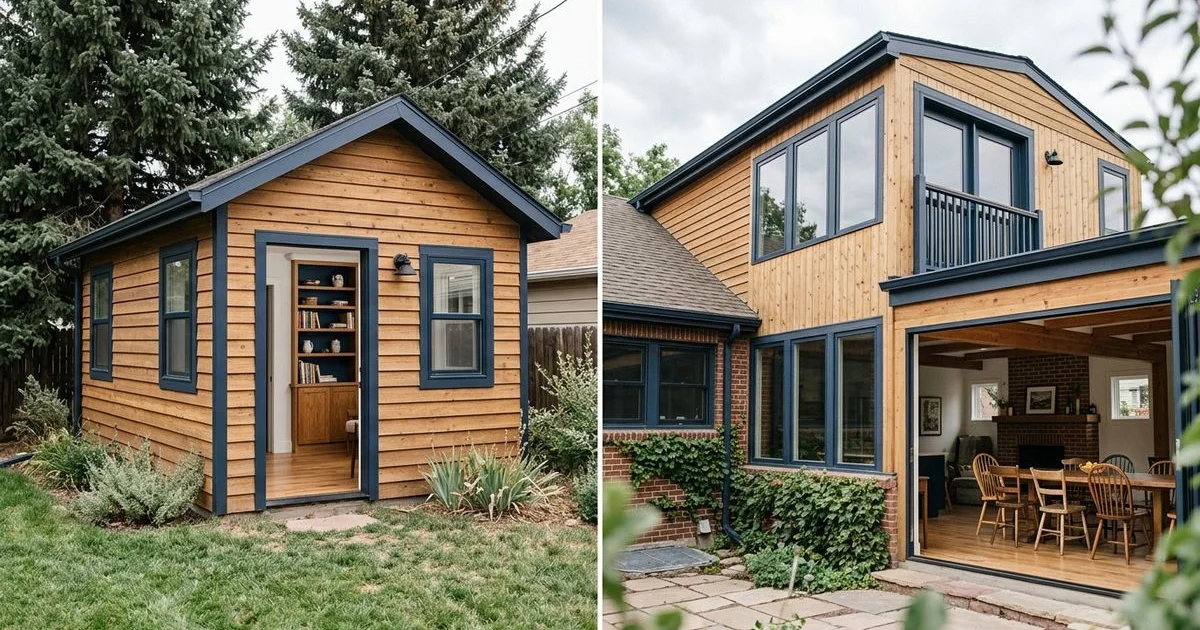
We see homeowners across the Greater Denver area facing the same critical property decision every day. Deciding between an adu vs home addition dictates your daily routine and your financial future.
Our team constantly speaks with clients who feel stuck figuring out if an adu or addition makes the most sense. Recent Colorado zoning shifts have made this exact choice more urgent than ever.
Let’s look at the data, what it actually means, and explore a few practical ways to respond.
The fundamental difference
The fundamental difference between an addition vs accessory dwelling comes down to integration versus true independence. A home addition expands your shared living footprint by adding new rooms that connect directly to your main utilities and hallways. An ADU creates a completely separate dwelling unit with its own kitchen, bathroom, and dedicated entrance.
We find that this distinction drives every other factor in the project. The right path depends entirely on what you need that new space to achieve.
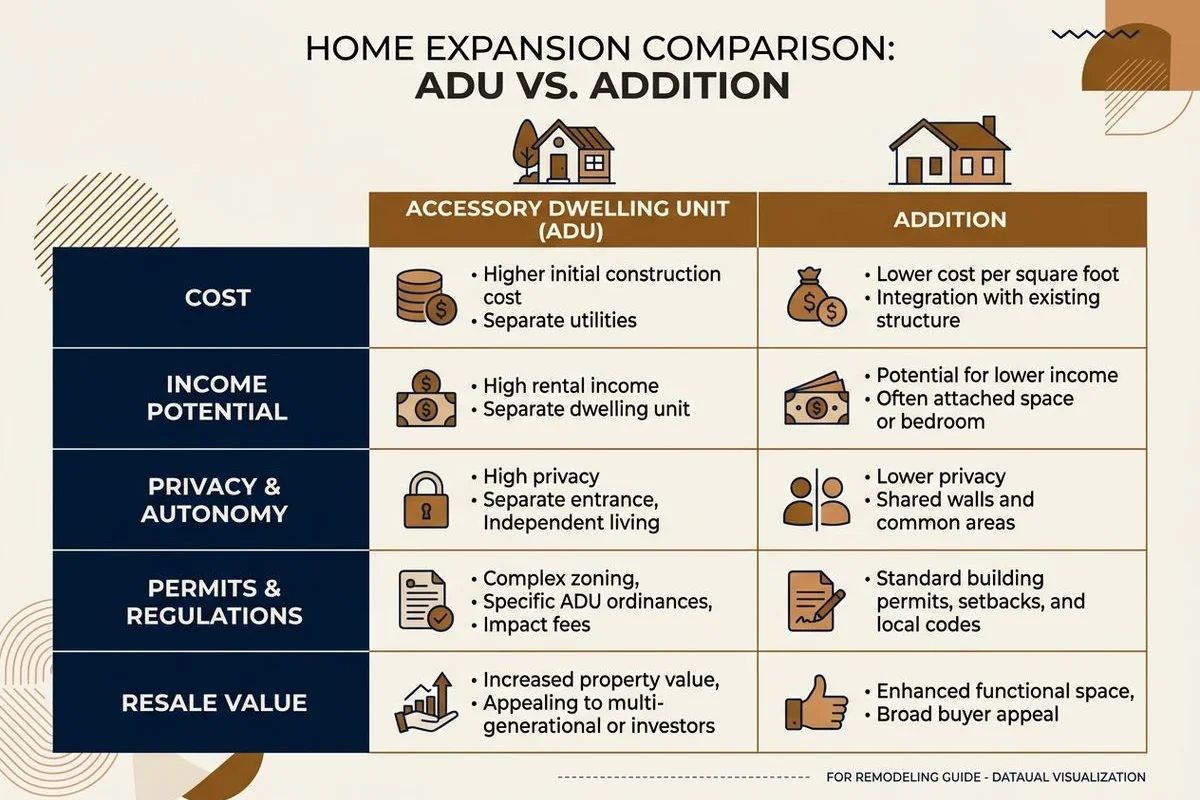
| Factor | Home Addition | ADU |
|---|---|---|
| Typical cost | $150k - $500k | $180k - $450k |
| Rental income | None | $1,500-$2,800/month |
| Privacy | Integrated with home | Fully independent |
| Permitting complexity | Moderate | High (separate utilities) |
| Resale boost | Strong on bedrooms | Strong on income proof |
| Best for | Family use, more rooms | Income, multigenerational |
When an addition is the right call
A traditional addition is the correct choice when your family needs connected space for daily living, like a larger kitchen or a primary suite. You want the new footprint to function smoothly as part of your existing floor plan.
Our data shows that most ground-level additions in Denver now cost between $200 and $500 per square foot. Building upward with a pop-top design costs even more due to structural reinforcements. We must also account for the expansive clay soils common across the Denver metro area. Specialized foundation requirements typically add $3 to $8 per square foot to ground-level projects based on local engineering standards.
Choose a home expansion over a separate unit when:
- You need extra bedrooms or a larger primary suite for your immediate household
- Your goal is shared living spaces rather than rental income generation
- Your lot has room for an expansion but lacks the clearance for a detached structure
- Family living means sharing meals and hallways on a daily basis
We always warn clients that new 2025 Denver building codes require strict energy efficiency standards. Upgraded R-value insulation and better windows add mandatory upfront costs to any expansion. A typical primary suite project in Arvada adds strong resale value but produces zero monthly income, making it best for personal comfort.
When an ADU is the right call
An ADU is the right call when your primary goals are generating rental income, achieving genuine privacy for family members, or maximizing your property’s appraisal value. A separate unit offers a distinct, lockable living space that functions without any reliance on the main house.
We have seen a massive spike in interest for these units since the passing of House Bill 24-1152. This 2025 Colorado law forces jurisdictions to allow by-right ADU construction and prevents homeowner associations from banning them outright. Our recent market analysis shows that a $250,000 detached unit can increase a property’s total value by 20% to 35% in the Denver area. That substantial equity boost pairs perfectly with the steady monthly cash flow.
You should plan for a separate dwelling unit when:
- Generating $1,500 to $2,800 in monthly rental income is a financial priority
- Multigenerational housing requires real privacy and a fully independent kitchen
- An adult child needs a self-sufficient space while saving money
- You want the highest possible appraisal premium at the time of resale
We highly recommend avoiding the most common design mistake of planning a basement conversion before verifying egress window requirements. Fixing this after the fact forces an expensive and time-consuming redesign when bedroom placements violate safe exit paths. For a full breakdown of the build budget, see our guide on ADU cost in Arvada.
The hybrid case (and when it works)
On larger Arvada lots, the best strategy sometimes involves doing both projects at once. You can build a modest extension for family living while simultaneously constructing a separate unit for income.
We handle these combined projects by running them sequentially under a single contract. Consolidating the design and engineering phases saves a significant amount of money and cuts down on total construction site fatigue. Our teams coordinate the heavy equipment for both structures to minimize the disruption to your property.
This hybrid approach makes sense when:
- Your property zoning and lot coverage limits allow for multiple structures
- Setback requirements accommodate both the expansion and the detached unit
- Your budget comfortably supports a combined investment exceeding $350,000
- Your long-term goals genuinely require both integrated and independent spaces
We never push clients toward this massive undertaking unless their lot perfectly supports it. Combining these efforts is simply the most efficient use of capital on a large residential parcel.
Privacy is the underrated variable
Most property conversations focus heavily on construction costs and final resale value. The highly underrated factor in this decision is how daily privacy impacts family relationships.
We know that building an attached suite for an aging parent puts them right across the hall from your busy morning routine. This shared schedule works perfectly for some families, but it often strains relationships within the first year. An independent unit puts your family members next door, separated by a physical wall or a short walk across the yard. They control their own kitchen, manage their own schedule, and watch their own television.
Physical separation is often the defining factor between a successful multigenerational living arrangement and one that causes daily frustration.
Our experience proves that having the option to retreat to a private space preserves family harmony. They can easily join you for dinner or choose to stay in for the night. The physical separation matters immensely for adult children, visiting in-laws, or college-age tenants. A separate entrance prevents the constant overlap of daily lives.
Where to start
The right choice depends entirely on your specific goals, lot size, budget, and family dynamics.
We want you to have all the facts before you commit to a massive construction project.
Book a free consultation and sit down with our team to walk through both options in person. You will get honest math and a clear look at the trade-offs right from the start.
Frequently Asked Questions
Is an ADU or an addition a better investment?
Which is cheaper, an ADU or an addition?
Can I do both?
More Guides in This Series
How Much Does It Cost to Build an ADU in Arvada?
ADU costs in Arvada by type — detached, attached and garage-conversion. See the price drivers and how rental income offsets the build.
How Much Rental Income Can an Arvada ADU Generate?
Arvada ADUs commonly rent for $1,500-$2,500/month. See the payback math, multigenerational uses and rental demand across the Denver metro.
Can I Build an ADU on My Property? Arvada Lot Coverage & Setbacks
Find out if your Arvada lot qualifies for an ADU. Learn the lot size, zoning, coverage and setback factors and how a feasibility assessment works.
How to Build a Code-Compliant ADU in Arvada & Jefferson County
Your guide to Arvada ADU rules: lot coverage, setbacks, utilities, water tap fees and the permit steps to build a legal accessory dwelling unit.
Learn more about Home Additions & ADU Construction
Ready to talk through your specific project? We'll meet you at home and walk through realistic budget and timeline ranges.