Basement Egress Window Requirements in Arvada
Egress windows are required for legal basement bedrooms in Arvada. Learn the size, well and ladder code, retrofit cost and why it matters for safety.
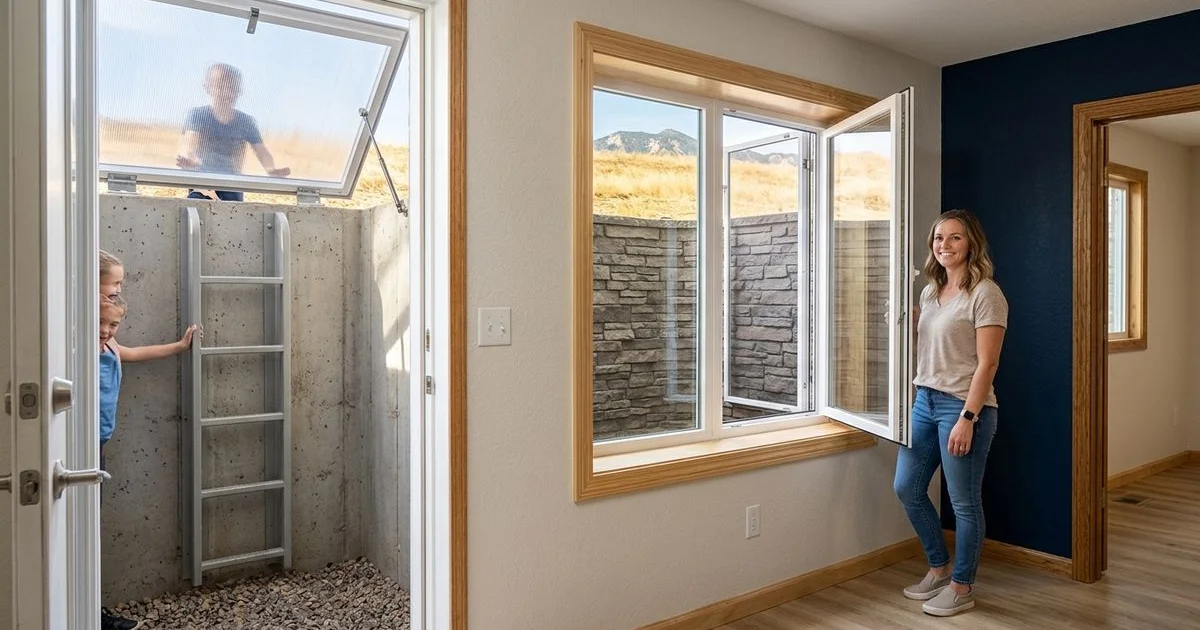
You know how finishing a lower level often feels like an endless checklist of rules and regulations. One specific detail that consistently catches homeowners off guard is the emergency escape layout. This single feature dictates what legally counts as a bedroom in the eyes of local inspectors.
Our team sees this confusion every week.
That is why understanding the International Residential Code is a foundational step before starting your project. Let’s look at the specific 2026 updates for the area and walk through the exact basement egress window requirements Arvada enforces.
Why egress windows matter
A basement egress window serves as the primary fire-safe escape route from a below-grade bedroom that lacks direct door access to the outside. If you cannot get out fast during a fire, the room simply fails to meet legal safety standards.
We prioritize these installations because they are quite literally life-saving features. The Arvada Fire Protection District emphasizes that most residential fire fatalities occur within the first five minutes. A properly sized opening gives your family an immediate exit and allows fully geared first responders to enter the home quickly.
Here are the three main reasons local officials strictly enforce these rules:
- Rapid Evacuation: Occupants need a clear, unobstructed path to safety when stairs are blocked by smoke.
- Rescue Access: Firefighters wearing bulky oxygen tanks require a minimum width to enter a burning structure.
- Legal Compliance: Selling a home with an unpermitted bedroom can derail a real estate transaction and trigger massive fines.
The code requirements (IRC R310)
To qualify as a code-compliant egress window in Arvada, the opening must meet four strict dimensional conditions. The city currently follows the 2024 International Residential Code (IRC) standards, which aligns with the updated egress window code Colorado builders must follow for the 2026 adoption cycle.
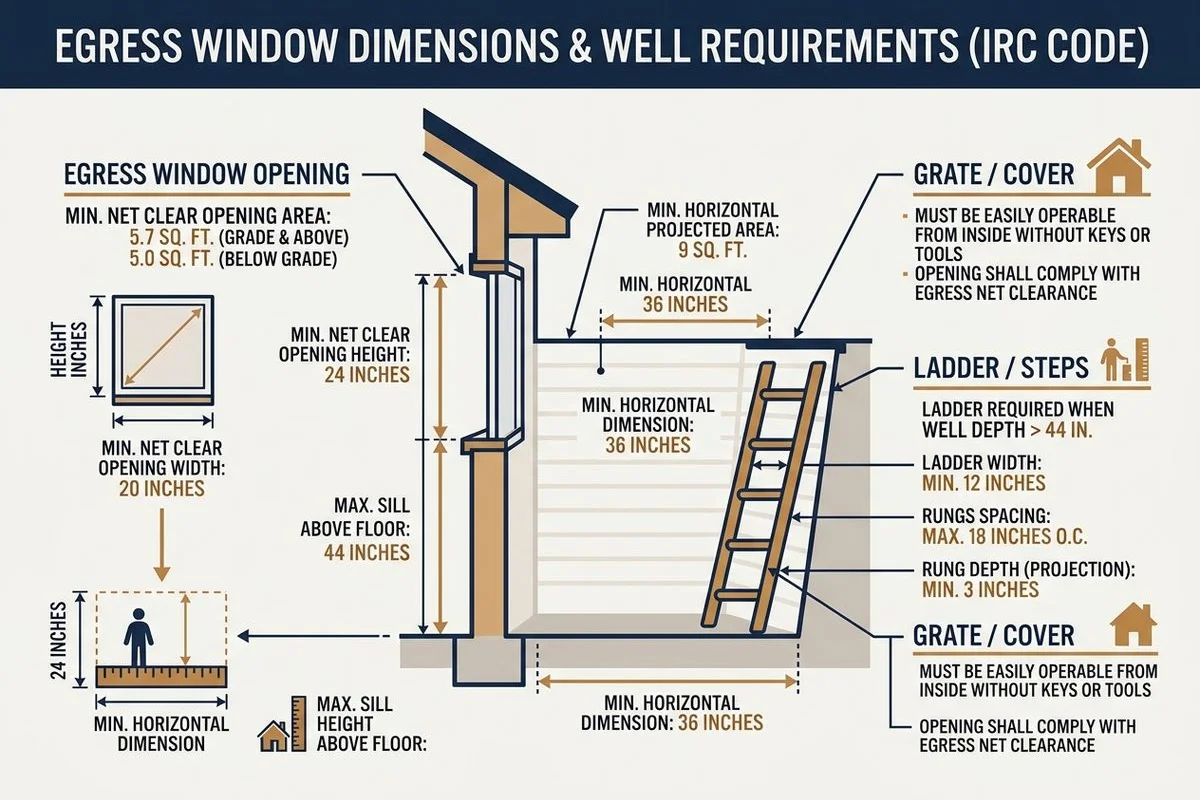
Window Dimension Minimums
Every replacement or new installation must hit specific numbers to pass inspection. A wide but short window will fail if it does not meet the independent height rule.
We always verify these four exact measurements on every job:
- Minimum net clear opening: The actual unobstructed area must be at least 5.7 square feet.
- Minimum opening height: The vertical clearance must hit 24 inches or more.
- Minimum opening width: The horizontal clearance needs to be at least 20 inches.
- Maximum sill height: The bottom of the opening cannot sit higher than 44 inches above the finished floor.
Window Well Specifications
Digging the exterior well comes with its own set of strict rules. If the window opens into a space below ground level, the surrounding earth must be properly retained.
Our contractors regularly fix DIY projects that fail the window well inspection. The well must provide a minimum of 9 square feet of horizontal floor area. It also requires a minimum projection of 36 inches from the foundation wall to allow a person to stand comfortably.
If your window well depth exceeds 44 inches, you are legally required to install a permanently affixed ladder or steps. This ladder must remain completely usable even when the casement is fully cranked open.
What it costs to retrofit
A typical egress window retrofit in the Greater Denver area costs between $2,700 and $5,900 in 2026. The final price tag depends heavily on your foundation type and the complexity of the exterior excavation.
We find that poured concrete foundations sit at the higher end of that pricing spectrum. Diamond-blade saw cutting requires specialized equipment and significant labor compared to removing older cinder blocks.
Upgrading your materials also impacts the budget. Many local homeowners choose RockWell composite fiberglass wells because they mimic the look of real stone and resist rust better than standard galvanized steel options like Boman Kemp.
Here is a typical breakdown of line items for a standard installation:
| Installation Component | 2026 Estimated Cost Range | Details |
|---|---|---|
| Excavation & Foundation Cutting | $800 to $1,400 | Diamond-blade saw work costs more than block removal. |
| Window Well Material | $400 to $900 | Steel is cheaper, while RockWell composite sits at the premium end. |
| Window Unit | $400 to $800 | Casement or sliding styles are the most common choices. |
| Ladder System | $150 to $350 | Mandatory for any well deeper than 44 inches. |
| Framing & Finish Work | $400 to $700 | Includes header installation and interior trim. |
| Labor, Permits & Inspection | $1,500 to $2,500 | Varies based on local municipality fees. |
Soil conditions and property access play a massive role in the final quote. A front-yard installation with easy machinery access is significantly cheaper than a tight backyard cut trapped behind a fence.
When you need one (and when you don’t)
You absolutely need an egress window if you are adding or finishing a bedroom in a basement that currently lacks one. Proper basement bedroom egress is heavily scrutinized by local zoning laws to ensure occupant safety.
Our project managers check the city permit requirements before finalizing any floor plan. You will be required to install an emergency escape in several specific scenarios.
You need an egress window when:
- Adding a brand new bedroom to an unfinished space.
- Creating a second bedroom in a basement that only has one existing escape route.
- Converting a bonus room, den, or office into a space that will be sold or used as a bedroom.
You might not need one for:
- Finished areas strictly used as recreation rooms, home theaters, or gyms.
- Walk-out basements where the sleeping area has a direct exterior door leading to the ground level.
- Spaces used exclusively to house mechanical equipment.
Always verify the intended use of the room with your local building department. Calling a space an office to avoid the requirement is a common mistake that backfires during a future home appraisal.
The safety case
The safety case is incredibly straightforward: a proper escape route ensures your family gets out safely and your insurance actually pays out after an incident. Skipping this upgrade to save money is a terrible idea, and Arvada inspectors will flag it immediately.
We ensure every basement bedroom we finish gets a code-compliant unit, with absolutely no exceptions.
The National Fire Protection Association notes that modern synthetic furnishings burn much faster than legacy materials, giving occupants only minutes to escape. A certified opening is your best defense against this rapid threat.
Our basement finishing team handles the entire installation process from start to finish.
This process includes the excavation, foundation cut, framing, window installation, well placement, ladder attachment, and permit filing. See our basement permits guide for what the full inspection sequence looks like in your neighborhood.
Frequently Asked Questions
Does every basement bedroom need an egress window?
How much does it cost to add an egress window?
Can I use my existing small basement window?
More Guides in This Series
Do I Need a Permit to Finish My Basement in Arvada?
Yes — finishing a basement in Arvada requires a permit. Learn what triggers it, the inspection process and why skipping it hurts resale.
What Does It Cost to Finish a Basement in Arvada?
Real Arvada basement finishing costs by size and finish level, plus what a bathroom, egress and wet bar add. See what's included in a fixed-price quote.
Wet Basement Solutions and Waterproofing Before Finishing
Got a damp basement? Learn the common moisture causes, waterproofing and drainage fixes, and why water must be solved before finishing — plus radon notes.
Learn more about Basement Finishing & Remodeling
Ready to talk through your specific project? We'll meet you at home and walk through realistic budget and timeline ranges.