Adding a Second Story to an Arvada Ranch Home
Thinking of popping the top on a mid-century Arvada ranch? Learn what's feasible, the foundation and load-path evaluation, timeline and living arrangements.
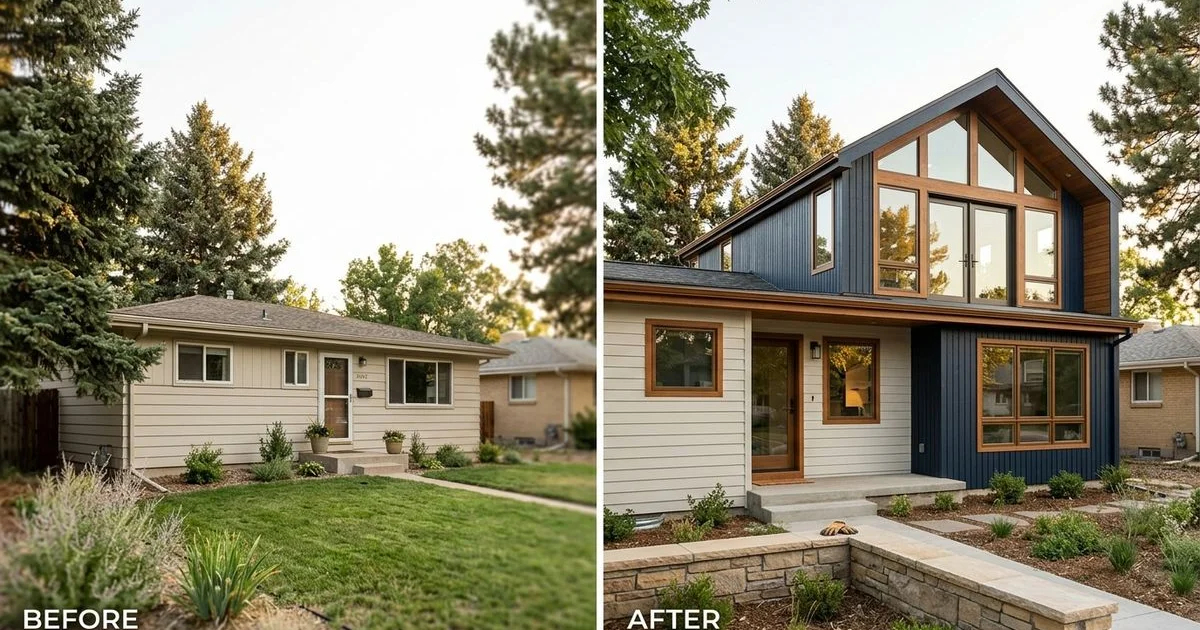
Homeowners across the Denver metro area know how tight the local real estate market has become. Finding a larger house in your current neighborhood is difficult and incredibly expensive.
Our team consistently recommends building upward as the most practical alternative.
Executing a second story addition ranch home arvada project requires careful planning. Let’s look at the data, what the city requires, and walk through the exact steps to complete this expansion successfully.
Arvada ranches are pop-top candidates
These mid-century structures are the best candidates for vertical expansions in the state. The original builders used solid poured-concrete foundations that readily accept additional weight.
We frequently transform these 1950s to 1970s properties into spacious two-story residences. A major advantage is that the first floor functions as a complete, livable home with a kitchen, living area, and bedrooms. This means a pop top ranch home design leaves your main floor intact while placing the new bedrooms and bathrooms above. Our clients love that preserving the main level footprint saves tens of thousands of dollars compared to a ground-level bump-out. Lot sizes in these older neighborhoods also provide excellent construction access for cranes and staging equipment.
Most were built with specific features that make them ideal for vertical expansion:
- Solid poured-concrete foundations with deep footings.
- 2x6 or 2x4 exterior wall framing on a slab or full basement.
- Roof structures that cleanly detach.
- Wide lot sizes for equipment staging.
What an engineer looks at
A Colorado-licensed structural engineer must evaluate your property before construction begins. They assess the foundation, load paths, and existing framing to ensure the house can hold a second floor.
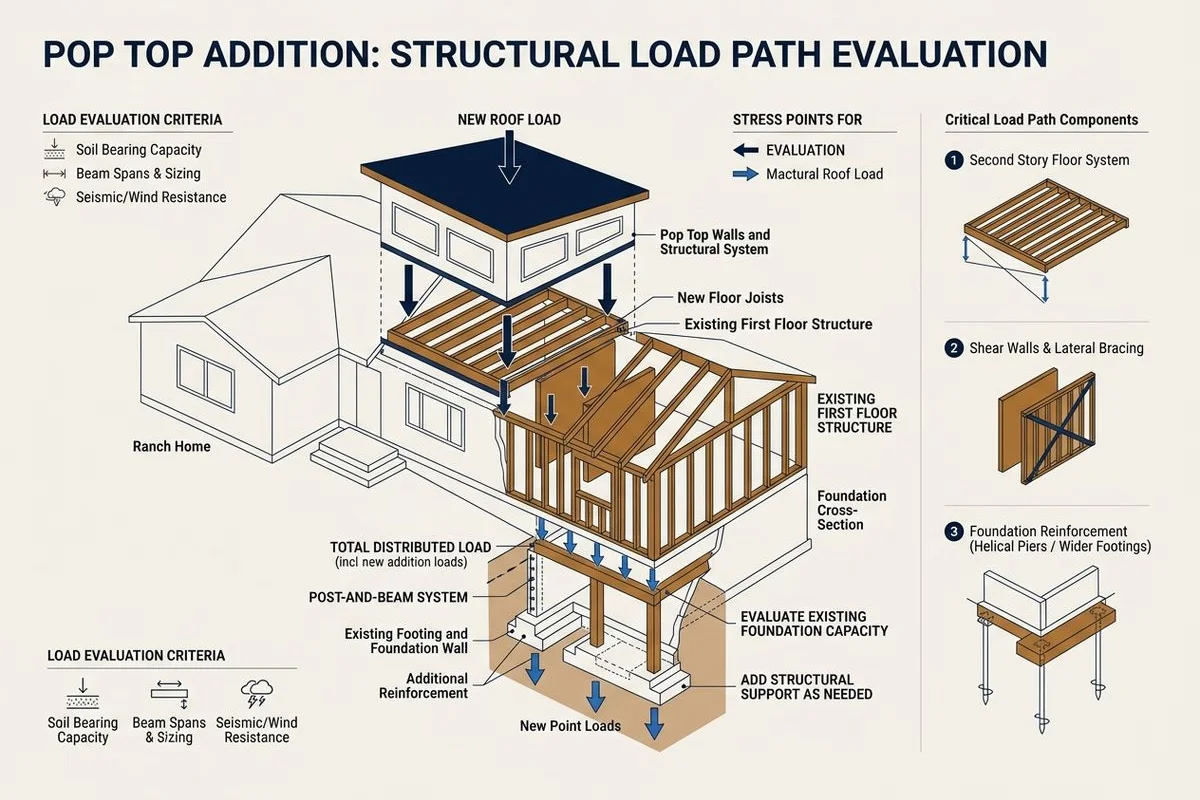
Adding a second story increases the structural load on your foundation by 50 to 100 percent. The engineer will produce stamped plans to meet the 2024 International Residential Code adopted by the city. We rely on their expertise to evaluate four critical areas:
- 1. Foundation capacity: The existing poured stem walls and footings must carry the new weight. We typically find that most local ranches pass this test with only localized reinforcement.
- 2. Load path: The structural load must travel safely from the new roof down to the existing foundation. Our engineers map this path through the new framing and the existing first-floor walls.
- 3. Existing wall framing: Many original first-floor walls are load-bearing. A new layout often puts weight on walls that currently hold no structural load.
- 4. Existing floor framing: Many expansions also affect the original ceiling and floor systems. The engineer evaluates whether the existing joists can carry the new stress.
We submit these stamped plans directly to the City of Arvada or Jefferson County along with your pop-top permit application.
What’s feasible on a mid-century Arvada ranch
You can typically add 800 to 1,400 square feet of living space to a standard lot. This size easily accommodates two or three new bedrooms, a primary suite, and extra bathrooms.
We encourage homeowners to weigh this against the high cost of buying a new house. Based on 2026 pricing, a 1,000 square foot addition in the Denver metro area costs between $250,000 and $450,000, and our breakdown of the full pop-top addition cost in Arvada shows exactly where that budget goes. A well-designed project to add second floor ranch spaces offers excellent return on investment.
We can add several premium features depending on your budget:
| Standard Scope Additions | Premium Custom Add-Ons |
|---|---|
| 800 to 1,400 sq ft of space | Roof deck (subject to setbacks) |
| 2 to 3 new bedrooms | Dormers for extra headroom |
| A dedicated primary suite | Open stairwell with natural light |
| Upstairs laundry room | Vaulted ceilings |
| 1 to 2 new bathrooms | Custom mountain view windows |
The new roofline will tie cleanly to the original first-floor exterior. You often gain unexpected mountain views by simply moving one level up.
What’s hard or unfeasible
Severe foundation cracking or properties without proper footings make vertical expansions incredibly difficult. These structural flaws require extensive and costly reinforcement before any new framing can begin.
We always check local zoning laws and structural limits before drafting plans. Properties located near the wildland urban interface now face stricter building guidelines under the Arvada Wildfire Resiliency Code. Another common roadblock is strict neighborhood rules.
Our team evaluates these risks during the initial site visit. Here are the most challenging scenarios:
- Severe foundation cracking: This indicates structural movement in the expansive clay soils common in our region.
- Crawlspace foundations: Homes without proper footings can be reinforced, but the cost increases the project budget significantly.
- Zero construction access: A property with no path for a crane or materials makes staging impossible.
- Adobe or unusual wall construction: These materials are rare in the local area but require specialized engineering.
- HOA restrictions: Neighborhoods prohibiting two-story homes will block the project entirely.
Addressing these issues early prevents massive cost overruns later.
Timeline expectations
A standard vertical expansion takes six to nine months from breaking ground to the final certificate of occupancy. You should also budget an additional three to five months for design and permits before construction starts.
We handle all scheduling to keep the project moving forward. The permitting process is taking longer across the Denver metro area in 2026. Arvada building plan reviews often take 8 to 14 weeks alone.
Here is a realistic timeline breakdown:
| Project Phase | Expected Duration |
|---|---|
| Design and engineering | 6 to 10 weeks |
| Permit review and issuance | 8 to 14 weeks |
| Demolition and structural work | 2 to 4 weeks |
| Roof tear-off through dry-in | 2 weeks (high-risk window) |
| Rough MEP and framing finish | 6 to 8 weeks |
| Insulation, drywall, finish work | 8 to 12 weeks |
| Final inspection and cleanup | 2 weeks |
Our project managers work closely with city inspectors to minimize delays. Weather conditions can impact the roof tear-off phase, so preparation is critical.
Living arrangements
You will need to move out during the most invasive parts of the construction process. The house is completely unlivable during the two-week roof tear-off and dry-in phase.
We map out the exact schedule before signing a contract so your family can plan accordingly. Many clients book a short-term rental nearby to stay close to the project.
The honest answer about staying in the house breaks down into clear phases:
- First 2 to 4 weeks: The house is typically livable during interior demolition and structural reinforcement.
- Roof tear-off through dry-in (10 to 14 days): You must relocate.
- Framing and rough MEP (4 to 6 weeks): This phase is sometimes livable depending on your noise and dust tolerance.
- Insulation through finish work (2 to 3 months): Downstairs functions normally, making the space usually livable.
- Final 2 weeks: The home is fully livable during cleanup.
Our project managers provide weekly updates to keep you informed. Schedule a free in-home consultation and we will evaluate your specific property to tell you honestly what is feasible.
A successful second story addition ranch home arvada expansion changes how you live in your space. We are ready to answer your questions and start drafting your new floor plan today.
Frequently Asked Questions
Can any ranch home support a second story?
Can we live in the home during a pop-top?
What's the structural-engineering process?
More Guides in This Series
How Much Does a Pop-Top Addition Cost in Arvada?
Pop-top additions in Arvada typically run $150k-$350k+. See the cost drivers, why they cost more than a basement finish and financing options.
What Is a Pop-Top Addition and How Does It Work?
A pop-top adds a second story to a single-story home. Learn why it's common on Front Range ranches, the high-level process and who it's for.
Learn more about Pop-Top (Second Story) Additions
Ready to talk through your specific project? We'll meet you at home and walk through realistic budget and timeline ranges.