How Much Does a Garage Conversion Cost in Arvada?
Garage conversions in Arvada typically run $25k-$70k. See the cost drivers — insulation, HVAC, plumbing, egress — and why it's cheaper than an addition.
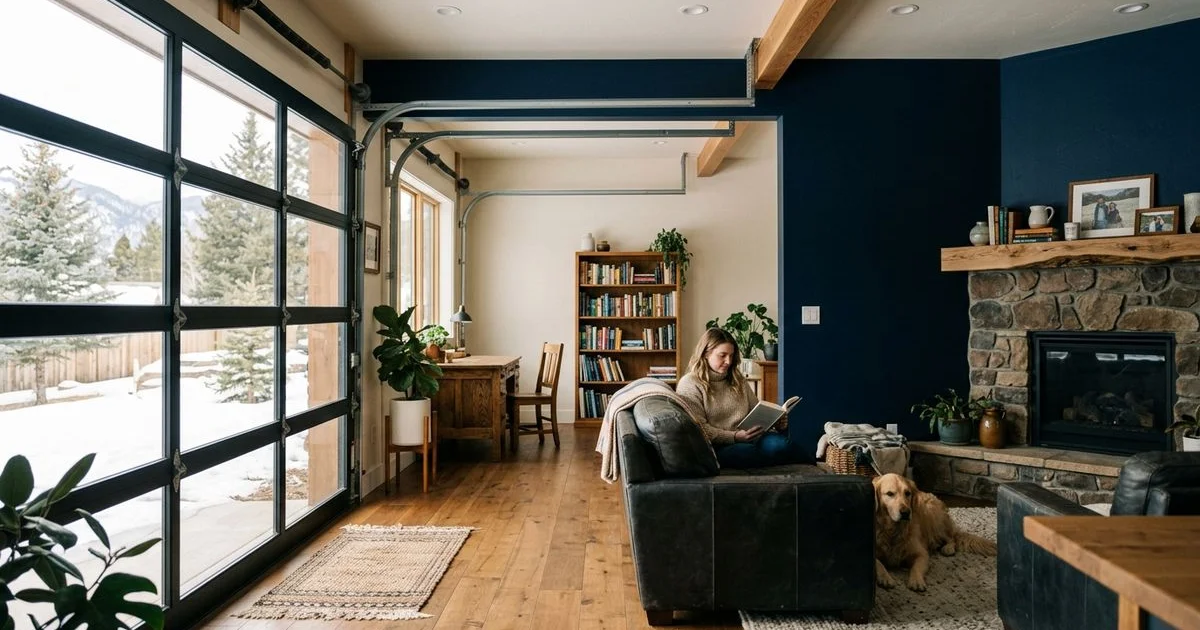
What a garage conversion costs in Arvada
Pinning down a realistic garage conversion cost in Arvada depends mostly on what you are converting it into. A basic flex room typically starts around $25,000, while a fully livable accessory dwelling unit easily exceeds $60,000.
That is an important financial distinction most people miss when pricing out new construction.
We, the team at Arvada Remodeling Pros, see these projects as the smartest way to gain square footage without altering your property lines. Here is how 2026 ranges typically break down in the Denver metro area.
| Conversion Type | Typical Range | What’s Included |
|---|---|---|
| Flex room / office | $25k to $40k | Insulation, drywall, flooring, lighting, HVAC tie-in |
| Bedroom (legal) | $30k to $50k | Above + egress, smoke/CO, full electrical |
| Living area + half bath | $40k to $60k | Above + half bath plumbing and finish |
| Full suite (bed + bath + kitchenette) | $55k to $85k | Above + kitchenette, full bath, separate entry |
| Garage-conversion ADU | $60k to $120k | Full habitable dwelling with all systems |
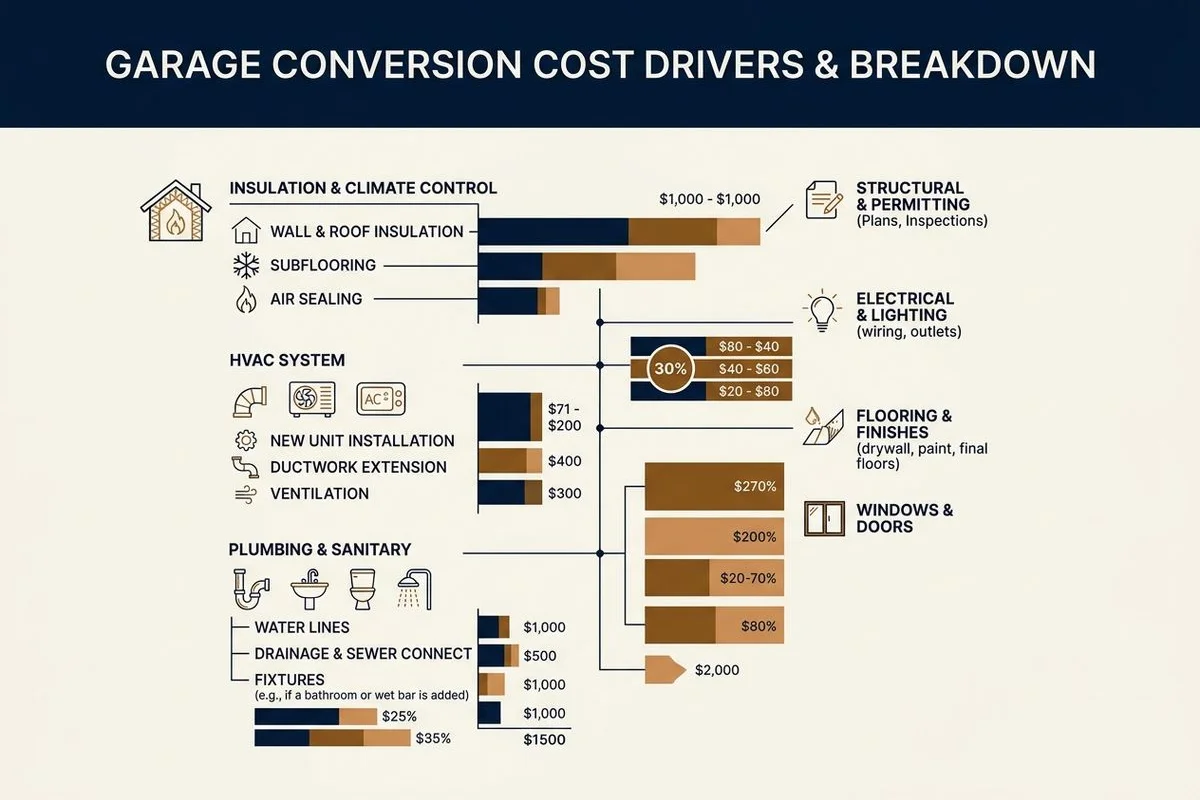
Where the money goes
A typical $45,000 garage conversion breaks down primarily into HVAC, insulation, finishing, and plumbing if required. Our local project data shows that mechanical systems and code-compliant framing take up the largest share of that budget.
Your overall garage to room cost depends heavily on the condition of the existing structure. Let’s look at the rough breakdown for a single-car garage transformed into an insulated flex room with basic climate control.
Structural and Exterior Modifications
Replacing the large door and upgrading the envelope requires significant framing work.
- Garage door removal and exterior wall framing: $3,000 to $5,000. This is often the most visible exterior change, requiring proper windows and siding to match the house.
- Insulation upgrades: $4,000 to $6,000. Meeting the 2026 Colorado energy codes often pushes homeowners toward spray foam on walls and ceilings, plus slab insulation for heated floors.
Mechanical Systems and Permitting
Getting utilities into the space is a major financial variable.
- HVAC extension or mini-split: $4,000 to $8,000. You can tap into the existing home HVAC to save money, or install a dedicated mini-split for superior climate control.
- Electrical upgrades: $3,500 to $5,500. Dedicated circuits, GFCI protection, and recessed lighting are standard requirements.
- City approvals and management: $3,000 to $5,000. The City of Arvada Building Division requires detailed architectural site plans before issuing permits.
Interior Finishes and Plumbing
The final touches make the room feel like a natural part of the home.
- Drywall, paint, and trim: $5,000 to $7,000. This turns raw studs into a finished living area.
- Flooring solutions: $3,000 to $5,000. Raised subfloors or specialized underlayments are often needed over concrete slabs.
- Plumbing additions (optional): $5,000 to $10,000. Adding a half bath or utility sink involves breaking concrete or running new water lines.
- Bath finishing (optional): $5,000 to $10,000. Tile, vanities, and fixtures add up quickly for full suites.
The cost drivers that matter
Insulation strategy, HVAC choices, and plumbing additions are the three biggest variables that control your final budget. We always advise clients to finalize these functional decisions before picking out cosmetic finishes. These core systems determine how comfortable the new room will actually be.
1. Insulation Strategy and Code Compliance
Garages were rarely built to current residential energy codes. Spray foam is the most reliable solution for getting a space up to the 2024 International Energy Conservation Code (IECC) compliance. This is especially true for the ceiling and the exterior walls.
Our insulation experts know that spray foam costs more upfront than traditional batt insulation. The superior air sealing performs better during cold Denver winters and actively prevents drafty cold spots.
2. HVAC Approach
Tapping the existing home HVAC works for small conversions if the main system has excess capacity. A dedicated mini-split is a much cleaner solution for larger conversions or spaces where precise temperature control matters.
Premium brands like Mitsubishi or Daikin run between $3,800 and $6,800 fully installed for a single-zone setup. Heat pumps also qualify for local Xcel Energy rebates, which can help offset that initial investment.
3. Plumbing Additions
Introducing water lines changes the entire scope of the job. Adding a basic half bath adds $5,000 to $8,000 to the total.
We see full bathrooms with showers adding $10,000 to $15,000. Installing a kitchenette with a sink and dishwasher adds roughly $4,000 to $7,000. Keep in mind that heavy plumbing might also trigger new System Development Charges (SDCs) from Metro Water Recovery.
4. Garage Door Treatment
Removing the main bay door and framing in a solid wall runs $3,000 to $5,000. Proper windows must be included for natural light and potentially for emergency escape routes.
Some homeowners try to save money by leaving the exterior door in place and building an interior wall behind it. This approach is cheaper, but it rarely looks intentional from the street view.
5. Egress for Legal Bedrooms
If the conversion becomes a legal sleeping area, specific escape routes are strictly enforced. An egress window is legally required, and existing small windows usually fall short of current code dimensions.
Our framing crews typically budget an additional $3,500 to $5,000 to cut concrete and install a compliant window well. This step is non-negotiable for official bedroom classification.
Why conversions beat additions on cost
Converting an existing structure is significantly cheaper than building from scratch because the foundation, framing, and roof are already in place. You avoid the massive expenses of pouring new concrete and erecting exterior walls.
We regularly compare these two approaches for local families. A 500-square-foot conversion typically saves $35,000 to $60,000 versus a brand-new addition of the exact same size.
Let’s look at the financial advantage of a garage conversion vs new addition for the same square footage. When comparing options, the convert garage cost is significantly cheaper across all major construction phases.
| Construction Phase | Existing Conversion Advantage | Estimated Savings |
|---|---|---|
| Foundation | Reusing the existing concrete slab | $8,000 to $15,000 |
| Structural Framing | Utilizing existing wall studs and roof trusses | $15,000 to $25,000 |
| Roofing System | Keeping the current shingles and decking | $5,000 to $10,000 |
| Exterior Siding | Making only minor localized modifications | $5,000 to $10,000 |
| Permits & Engineering | Navigating a much lighter administrative scope | $3,000 to $8,000 |
Is it worth losing the garage?
The honest answer depends entirely on your home layout, parking availability, and specific neighborhood dynamics. Losing covered parking makes sense if the indoor living space drastically improves your daily life or generates rental income.
We evaluate this tradeoff during every initial consultation. Here is how different property types usually fare in the Arvada area.
Assessing Your Property Type
- Most ranches in Arvada: These homes usually have a long driveway, meaning the conversion adds far more functional value than the covered parking provided.
- Homes without driveways: Properties relying solely on street parking may lose more market appeal than they gain from the extra room.
- Homes already at limited parking: Neighborhoods with strict parking rules may face strong pushback from local HOAs.
- Homes with detached garages: These setups are ideal because you can convert the attached space without losing all covered vehicle storage.
The ADU Income Potential
The other major consideration is creating a fully independent accessory dwelling unit (ADU). Colorado’s recent statewide zoning laws, specifically HB24-1152, have forced cities to streamline administrative approvals for these spaces.
Our design team notes that an Arvada garage-conversion ADU keeps the original structure visible from the street while adding significant rental income potential. A permitted 500-square-foot unit can quickly turn an unused storage bay into a powerful financial asset.
Where to start
Finding the most accurate garage conversion cost in Arvada depends entirely on your specific home footprint, your family goals, and your available budget. Gathering exact measurements and local code facts is the best first step.
We encourage you to talk to our team about what your unused space could realistically become. A quick conversation will clarify your options and outline a practical path forward.
Frequently Asked Questions
How much does a garage conversion cost in Arvada?
Why is a conversion cheaper than an addition?
Will I lose value losing the garage?
Learn more about Garage & Attic Conversions
Ready to talk through your specific project? We'll meet you at home and walk through realistic budget and timeline ranges.